 Rockers,
 made in 1978, it's a fairly authentic portrait of Jamaican musician life at the time, from wikipedia: "The main rocker Leroy "Horsemouth" Wallace, for example, is shown living with his actual wife and kids and in his own home. The recording studios shown are the famous Harry J Studios where many roots reggae artists recorded during the 1970s including Bob Marley." The film features a lot of musical talent, for example the better known Gregory Issac, Big Youth, and Jacob Miller, would die 2 years later in a car accident at the age of 27*. It's worth watching for the 70s style and it's musical moments. It also feels artistically constructed in a way films rarely are anymore. From Horsemouth's hat to records themselves, circles are a reoccurring element in the film.
*(
here's Horsemouth in 2012 talking about Jacob Miller and claiming a policeman who tasked with taking Jacob to the hospital post car crash, first stopped for a beer, in part because he was a Rasta).
If you know much about Jamaica, you're probably familiar with the trope of the rich "society" people and or the police being corrupt and predative.
It's a common theme seen in a lot of Jamaica's cultural output, even today. Rockers is one part the bicycle thief and one part Robin Hood, and is driven (all be it slowly) by this trope. In this case a well to do Jamaican who runs a resort catering to white tourists is also stealing all manner of goods and storing them in a big warehouse, presumably to be turned around resold on the street.


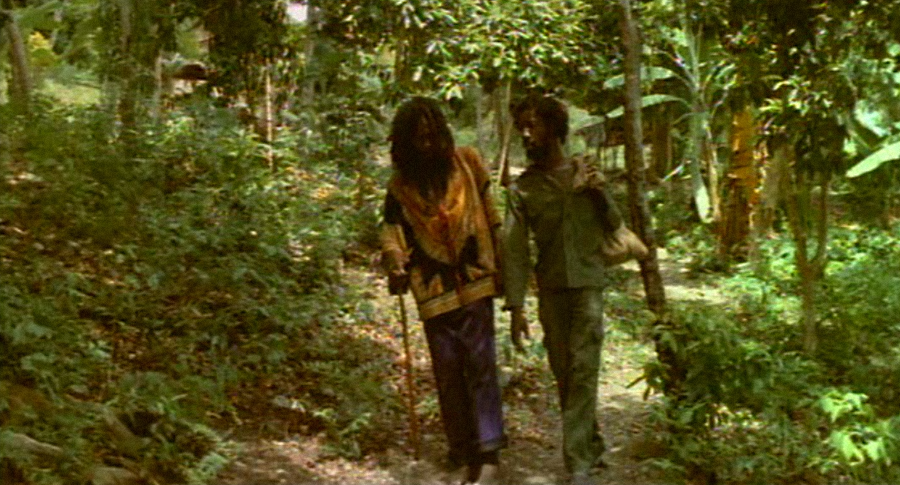

The fact that Rastafarians are marginalized and occasionally run into discrimination is touched upon too. At one point in the middle of the film, Horsemouth is pushed to the ground, only to get up an turn to the address the camera about how as a Rasta he would never resort to violence. However, later when getting his robin hood like revenge, he and others can be seen beating people up. It seems to suggest at a bit of hypocrisy, or at least question whether it's possibly to stay so virtuous in a corrupt environment.


When the robin hood quest is complete, the hot items are re-stolen out of the warehouse and put on the street for free. Even though it's a victory, there's a sense that there is one more circular element for us to discover, and that's the tit-for-tat viscous cycle of injury and retribution, one that has the ability to lead to greater violence, like in the 1976 and later 1980 elections when Jamaica had it's share division and tit for tat (serious) gun violence.
Up next for me is the earlier [and probably stronger] film
"The Harder They Come" starring Jimmy Cliff.

 I had heard about They Live years ago then forgot about it, and rarely heard it mentioned, until I recently watched Slavoj Žižek's Perverts Guide to Ideology. They Live is described is described by Slavoj as:
"one of the forgotten masterpieces of the Hollywood Left. ... The sunglasses function like a critique of ideology. They allow you to see the real message beneath all the propaganda, glitz, posters and so on. ... When you put the sunglasses on you see the dictatorship in democracy, the invisible order which sustains your apparent freedom."
I had heard about They Live years ago then forgot about it, and rarely heard it mentioned, until I recently watched Slavoj Žižek's Perverts Guide to Ideology. They Live is described is described by Slavoj as:
"one of the forgotten masterpieces of the Hollywood Left. ... The sunglasses function like a critique of ideology. They allow you to see the real message beneath all the propaganda, glitz, posters and so on. ... When you put the sunglasses on you see the dictatorship in democracy, the invisible order which sustains your apparent freedom." 
 Just your everyday police brutality.
 They Live's visual style of it's propaganda, echos Barbara Kruger—and inspired a younger Shepard Fairey to use "OBEY".
The aliens were deliberately made to look like ghouls according to Carpenter, who said: "The creatures are corrupting us, so they, themselves, are corruptions of human beings." [Wikipedia]
They Live's visual style of it's propaganda, echos Barbara Kruger—and inspired a younger Shepard Fairey to use "OBEY".
The aliens were deliberately made to look like ghouls according to Carpenter, who said: "The creatures are corrupting us, so they, themselves, are corruptions of human beings." [Wikipedia]


 Police mainly function as a controlling force for the aliens.


 The country's elite are either enriching themselves by co-operating with the aliens (selling out) or are actually aliens
themselves. Also, I love when you hear a sample you've heard a hundred times, unexpectedly from the source, as I did with
the opening of Binary Star's "Indy 500". The sample
feature's a bit of They Live dialogue with a character saying at one point "what's the threat? We all sell out every day, mine as well be on the winning team"
According to the director John Carpenter, when pitching the film and explaining "They want to own all our businesses" A Universal executive asked him "Where's the threat in that? We all sell out every day."—"I ended up using that line in the film." said Carpenter [Wikipedia]
The country's elite are either enriching themselves by co-operating with the aliens (selling out) or are actually aliens
themselves. Also, I love when you hear a sample you've heard a hundred times, unexpectedly from the source, as I did with
the opening of Binary Star's "Indy 500". The sample
feature's a bit of They Live dialogue with a character saying at one point "what's the threat? We all sell out every day, mine as well be on the winning team"
According to the director John Carpenter, when pitching the film and explaining "They want to own all our businesses" A Universal executive asked him "Where's the threat in that? We all sell out every day."—"I ended up using that line in the film." said Carpenter [Wikipedia] 
 In the end, the jig is up.

 "The only black man on the executive board of an advertising firm, is accidentally put in charge after the unexpected death of the chairman of the board. Renaming the business "Truth and Soul, Inc.", Swope replaces all but one of the white employees and insists they no longer accept business from companies that produce alcohol, war toys, or tobacco."


